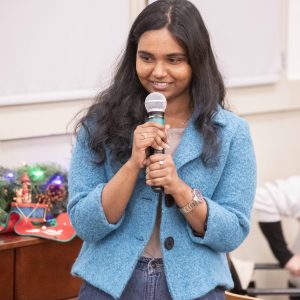
Name: Priya Vallabi
Cohort: BA Class of 2027
What were you doing before DRBU?
I’m not from a single track…I’m built from many chapters, and each internship I worked for has taught my heart a different mode of serving people. One of the most influential, recent chapters was in 2023 when I served as an United Nations active permanent volunteer. My United Nations visit to New York has changed my perspective on workspace values and what true impact means in public life.
What does contemplative practice mean to you? What practice do you do in your spare time (if any)?
Well, I love exploring different types of spiritual and mindful practices. One of the recent ones is Trekchö. I do it every day because it’s the one practice that makes me feel untouchable inside. I like it because I don’t have to fix my citta (thoughts). I just sit, recognize awareness, and everything heavy loosens by itself. I also have had this constant Ajapa practice of divine Shakti since I was a kid.
What is an influential class, book, or concept that blew your mind?
A book that really stayed with me is The Seven Daoist Masters: Classic Tales. It’s by my all-time favorite author, Eva Wong. It makes us notice how much of Doaist principles can sit inside simple stories, and how the universe can teach us the Dao if our will is strong and unwavering.
Also, The Divine Comedy by Dante. This is the one that I still remember re-reading lines from in the midst of the scent of brewing coffee at NY’s vintage Dante cafe this winter. I fell in love with his idea of the person who chooses neither: not extreme good, not extreme evil, just remaining neutral, passive, refusing to commit. And how that person ends up belonging nowhere—not Hell, not Heaven.
It made me think: we don’t get to call avoidance “balance.” We don’t get to call silence “peace,” either. Sometimes choosing nothing is still a choice, and it has its own consequences. It gives this century some direction for not falling into traps of neutrality, and promotes standing for something we believe and have faith in.
Can you share a memory of a quintessential DRBU moment with us?
My quintessential DRBU moment is during free time or weekends when I just leave everything behind and either walk or bike to the backwater creek. I sit under Zeleny—my buddy, my old oak tree….and I journal. That spot has this quiet vibe to it. Living in the moment with nature with many small creatures around me, the air itself feels like it’s reminding me to unclench, to stop sprinting through my own life. I always come back softer and clearer after that.
What do you plan to do after DRBU?
In the near future, I want to become a bureaucrat in India and bring some freshness into the world’s largest democratic and historic working constitution. I want to be in the places where policy becomes true, where basic utilities, support, and dignity reach people. I want to make sure they do. I don’t want children in the districts I serve going to sleep with empty stomachs while files move from desk to desk. I want the system to actually work for the people it’s meant for, and I want to be the kind of sapien who follows things through until they become real.
And later, I want to design a home that feels like a small stream or a beautiful pond. A house full of adopted kids, sheltered animals, and any beings who just need somewhere safe to land.
Thank you for reflections, Priya!