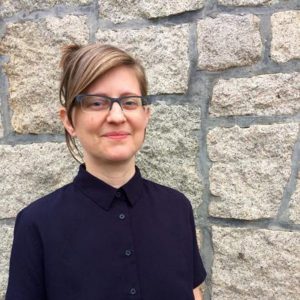
This fall DRBU had the privilege to welcome Professor Amanda Goodman to its faculty. Professor Goodman was gracious enough to share with us some of her story and what she’s excited about at DRBU.
Could you tell us a little of your story? How did you come to academia?
I came to academia through my love of literature, philosophy, and the world’s wisdom traditions. I first became interested in Buddhism as a high school student and went on to complete a bachelor’s degree in Comparative Literature and Chinese. I was fortunate enough to study in Taiwan during my undergraduate years, and it was there that I really began reading Buddhist sūtras in Classical Chinese. That interest eventually led me to graduate study in Buddhist Studies, where I focused on medieval Chinese Buddhism. What has kept me in academia is really quite simple: I love reading difficult and beautiful texts, thinking about them with other people, and having the chance to keep learning.
What is your scholarly background? Are you working on anything right now?
My research focuses on Chinese Buddhism, especially on the ways medieval Chinese Buddhists used ritual to prepare for and participate in the process of awakening. Much of my work centers on the extraordinary cache of medieval manuscripts discovered in the Mogao Buddhist cave complex near Dunhuang, an important oasis town along the old Silk Road in what is now Gansu Province, China. These manuscripts preserve everything from Buddhist sūtras and ritual texts to study notes, lay and monastic records, and other materials that offer a rare glimpse into how Buddhism was actually studied and practiced more than a thousand years ago. I’m currently working on a book project that draws on both Dunhuang manuscripts and canonical sources to explore how an important early Esoteric Buddhist tradition was transmitted to China and transformed there.
What drew you to Dharma Realm Buddhist University?
What drew me most strongly to DRBU was its commitment to taking texts seriously—not simply as historical objects to be analyzed (though as a philologist, I do like to do that, too!), but as works that can still ask something of us. I was especially interested in the idea of transformative reading: that our encounters with texts might actually change the way we understand ourselves and the world. That’s also what attracts me to DRBU’s emphasis on shared inquiry and to the idea that education involves the formation of the whole person. As someone who has spent much of my life studying Buddhism, it is especially meaningful to be part of a community where it is not merely an academic subject but part of a living tradition.
What are you looking forward to at DRBU?
I’m especially looking forward to getting to know my students and colleagues across the seminar table. Some of my favorite moments so far have been the unexpected ones: when a student notices something in a text that I hadn’t noticed before, or when a discussion takes a turn none of us anticipated. I’m also excited to be teaching well outside my own field—from the Analects to the Hebrew Bible and Homer. I find it enormously rewarding to bring insights from one tradition into conversation with another and to discover unexpected threads between them. Those connections can reveal something not only about the traditions we are studying, but also about our shared human experience. One of the great pleasures of being at DRBU is getting to be a student again.
Is there anything else you want to share with us?
I’ve just moved back to the U.S. after living in Canada for 20 years, and I’m brand new to Northern California. Life outside the classroom currently involves a fair amount of exploring Ukiah and the incredible landscape surrounding it. I came here from Toronto this summer with my cat, Atticus, who has become an enthusiastic observer of Ukiah’s bird population. I also have two grown sons—one studying law and the other training to be a teacher—so this move marks a new chapter for my family. I’m deeply grateful for the warmth and generosity with which I’ve been welcomed into the DRBU community.