Presence, Connection, Atmospheres: The Internal, Internal-External and External Dimensions of Subjectivity in Early Buddhist Mindfulness and Compassion
A talk by Bhikkhunī Dhammadinnā
The early Buddhist instructions on the four establishments of presence or mindfulness call for contemplation internally, externally, and internally-and-externally. This talk reads these three terms not only as meditation guidelines but also as pointers to how subjective experience is structured. Likewise, compassion is cultivated by radiating it boundlessly in all directions, pervading a shared space inhabited, as a matter of fact, by self and other. Presence therefore does not simply mean attention turned inward, and connection does not require merging or the use of normative discourses of interconnectedness. Both rest on a fundamental recognition of, and undistorted attunement to, what is conceived as the baseline reality of the subject in their world. Contemporary phenomenology and phenomenological psychopathology describe a comparable structure in terms of the lived or living body (Leib) – attuned to a spatially diffused ‘atmospheric’ field located neither inside nor outside – and empathy (Einfühlung), both of which play central epistemic and existential roles.
About the Speaker
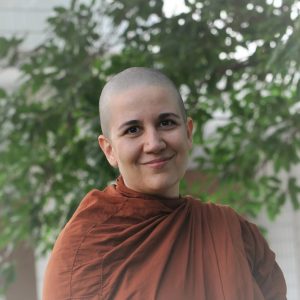
Born in Italy, Bhikkhunī Dhammadinnā was ordained in the Theravāda tradition in Sri Lanka in 2012. She holds a PhD from the University of Naples ‘L’Orientale’ and researches early Buddhist discourses, the development of Buddhist meditative traditions, and institutional ideologies. She co-founded and directs the Āgama Research Group, serves as a visiting associate research professor at Taiwan’s Dharma Drum Institute of Liberal Arts, and is currently Numata Visiting Professor at UC Berkeley. Practicing meditation since 1996 and teaching internationally since 2017, she draws on early Buddhist sources while attending to how historical, institutional and ideological contexts shape practice and practitioners’ lives and working with trauma- and dissociation-informed approaches to Buddhist practice.
Date: Sunday, November 8
Time: 7:00 to 8:30 PM
Location: Sudhana Center, Buddha Hall, Ukiah